Inflatable Snakes and Politics

By: Sallie Hardy

As I’ve previously stated, the other students who are with me on this trip are journalists and political scientists while I’m a media analyst. This doesn’t mean that I’m carefully analyzing everything being written for correctness and conciseness. That isn’t the media I study. What it does mean is that movements and trends on Twitter catch my eye. After attending the Democratic Debate on Tuesday, many students and I saw a contentious exchange between Elizabeth Warren and Bernie Sanders (with Tom Steyer lurking in the background). This exchange has become popular in news coverage and debate analysis as trends and movements on Twitter and other social media platforms have surged. These patterns are exactly what media analysts search for. 

This new trending movement on Twitter includes hashtags like #warrenisasnake, #warrenlies, and #neverwarren. The hashtags began appearing after the debate on Tuesday when Warren maintained her stance that Sanders had indeed said a woman could not win the presidency. Whether this is true or not, the hashtags are trending, and both sides are using them. After the Sanders’ fans used them to slander Warren and hurt her name, Warren’s followers began using them to stand up to the other side even though being called a snake is not something you’d think anyone would accept. I mean, snakes are thought of as slimy and devious.

A similar trend appeared a few years ago in the pop-culture world in between celebrities Kim Kardashian and Taylor Swift… and Swift decided to claim the title and use it to her benefit. A snake was featured on Swift’s album cover after the issue, and she would regularly bring an inflatable snake to concerts to prove a point. It looks like the snake emoji is making its debut in the political world in a similar way. 

I can’t predict the future and say that Warren will bring an inflatable snake with her to rallies from here on out, but I do think this speaks volumes as to where we are as a society. Presidential candidates are no longer politicians to a younger generation: they are celebrities. Candidates have communities following them similar to those of a rockstar with groupies, trolls, and hoards of social media fans. What this will mean in November? I can only hope people will be able to put their political fandoms aside and seek truth instead of blindly jumping onto whatever is trending at the moment. I’ll be there analyzing it.
Overcoming the viability of women candidates

By Martha Selph

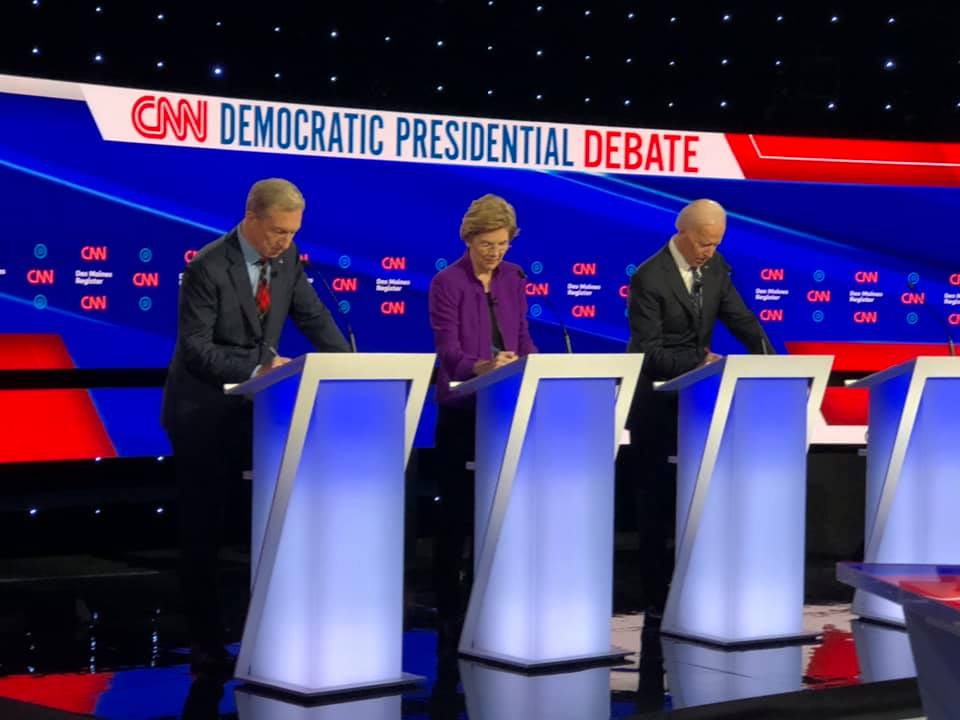
One of the most discussed moments at the Democratic Debate on Tuesday at Drake University was not the incredibly well thought out answers by the people on stage or the witty banter between the candidates, particularly Senator Elizabeth Warren’s comment about how collectively, the men on stage have lost ten elections. Although Warren’s snappy comeback was my favorite moment of the debate, it was overlooked by something that happened after the debate came to an end. Senator Warren and Sanders met for a post-debate discussion, and when Sanders extended his hand for a handshake, it was refused. This interaction has been heavily scrutinized by news outlets and viewers on social media for the past three days and has led to the Twitter hashtag movement, #NeverWarren. Perhaps this reaction to Warren’s ‘snub’ of Bernie is unsurprising after tensions have been on the rise between the two progressive candidates lately, ever since the Sanders campaign began giving their volunteers a script that attacked Warren by name. In response, it was leaked that Sanders told Warren during a private meeting years ago that a woman could not beat Trump in 2020. While Sanders denied this happened, Warren and her campaign continued to say that he did. When asked about this in the debate, the issue appeared to be settled until the handshake incident. 

The backlash towards Warren I have seen from Bernie supporters and others on social media has really bothered me for a multitude of reasons. To begin with, this all seems rather unimportant when impeachment is going on in D.C., and it is more vital than ever for the Democratic party to be united. At the end of the day, there will be one Democratic nominee to run against Trump, and I hope that something as small as a handshake does not prevent voters from supporting whoever the nominee may be. I believe this also brings up an important issue about gender, sexism, and the viability of a woman candidate in the 2020 election. Polls have shown that a majority of voters would be comfortable with a woman, and when looking back at history, we see that people never thought a Catholic or an African American could become President, but then did. However, I am hesitant to believe that the country would really rally behind a woman candidate, particularly Elizabeth Warren. Biden continues to be seen as the candidate who is seen as the Democrat’s best chance to beat Trump, despite having a poor track record of winning in Republican areas and has lost many more elections than Warren or Klobuchur. People see Biden as a more electable candidate, and perhaps that has to do with his gender and race. People are comfortable with him and are familiar with white men in the Oval Office.  

When I hear people say, “I’d vote for a woman, just not Warren,” or in 2016, when people said this about Hillary Clinton, I think, if not now, then when? I believe we hold our female candidates to a higher standard than we do the male candidates and are more inclined to criticize them and vilify them for things that we never would of a man. As we approach the Iowa Caucuses and the primaries across the Nation, it is more important than ever to recognize our biases as voters and to step into the voting booth with an open mind. I don’t think we need to be concerned with whether or not a woman like Warren is electable, but rather who is best suited to be the President of the United States. It will be interesting to see how the ‘beef’ between Warren and Sanders and the topic of a female in the Oval Office will play out in the upcoming months. My hope is that both campaigns turn a corner and stop attacking one another and turn their efforts to the real enemy: Donald Trump. 

Working for an Underdog

By Liz Crouse

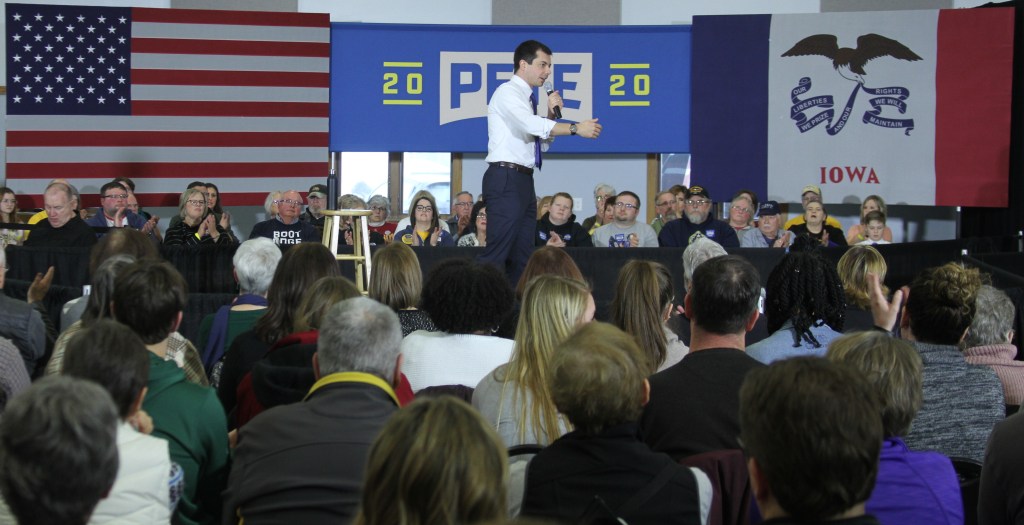
Last night, I received an email from Mayor Pete Buttigieg’s campaign entitled “The reality of being an underdog in this campaign.” This was no surprise – though he’s polling well in Iowa and New Hampshire, I’m not fooling myself into thinking his road to the presidency is a sure bet or even a likely one. The only other campaign I worked on was for a young lawyer, Wiley Nickel, who was a Democrat in a heavily gerrymandered blue district, so he wasn’t likely to lose. Pete is. I loved working on Nickel’s campaign, but there’s something even more exciting about working for an underdog, especially for the underdog in a presidential campaign.

It struck me on the very first day in the office that the campaign workers are passionate. They’re not on board with his campaign because they know he’ll win, but they fight tooth and nail to get him to win Iowa, and they’re seeing it pay off in the polls. They’re seeing more and more people say “I support Pete” when they knock on doors and more volunteers come into the office daily. In spite of a national polling average of only about nine percent and a New York Times study that gives him only a ten percent chance to win a majority of delegates, the precinct organizers in our office daily step into the cold, into the snow, and into the fear of rejection, all of which are extremely real. Maybe it isn’t in spite of his low poll numbers, but because of them, that they fight so hard. There’s a spark in their eyes and a fire in their bellies.

Yesterday, a young couple came into the office and asked to have a yard sign and to sign up for canvassing. They were greeted with extreme gratitude and humility. Virtually every campaign worker and volunteer smiled from ear to ear and thanked the two new volunteers. I knew in that moment that no volunteer, no organizer, no homeowner who opens the door and signs a “commit to caucus for Pete” card is taken for granted in that campaign. Not one.

Working for an underdog can definitely become disheartening at times. When the Monmouth poll came out that shared results that Biden was now ahead in Iowa, the disappointment in the air was palpable. Realistically, Pete Buttigieg is in fourth place nationally. Most polls are disappointing. But the campaign workers don’t let discouragement keep them down for long. Instead, they treat each poll as a reason to work harder. A reason to make more phone calls. A reason to knock on more doors.

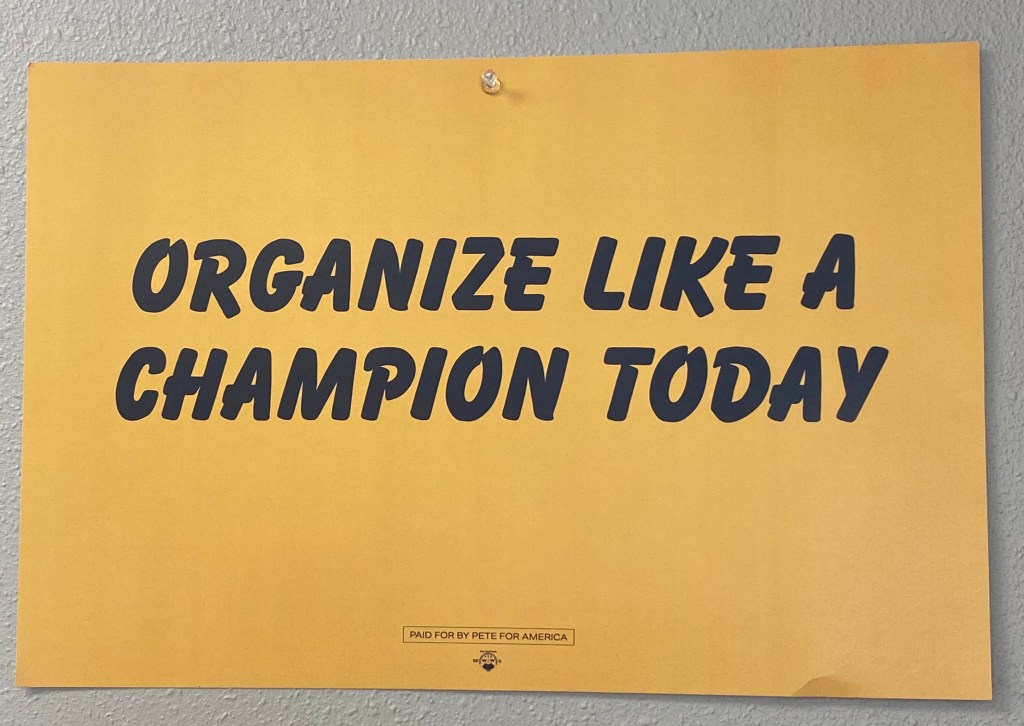
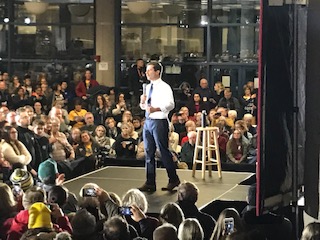
Pete’s rally on Sunday

This experience has humbled me, but it has also shown me a passion for the underdog I never knew I had. My high school principal used to read a quote over the intercom in the morning that said, “Everyone loves an underdog, but no one wants to support one. Support one anyway.” I never really understood this; isn’t it easier and more fun to support someone who will likely win? After working on the Buttigieg campaign, I’d argue that it isn’t. I think it’s more fulfilling because every victory, every point in the polls, every signature means that much more. And, I think you’d be hard-pressed to find people more dedicated to any cause  than Julia, Kyle, Sam, Grayson, Kelsey… the list goes on. And that passion is inspiring to be around.

I’m not denying that Pete has less political experience than his colleagues. I’m not denying that many people in our little office on Fleur Drive in Des Moines are young, and some are working on their first campaign. But I can attest that this campaign has the most dedicated and inspired organizers and volunteers that I’ve ever met. 

Whatever happens, I’m proud to work on a campaign of hardworking, humble members behind a candidate we all believe in.

Recognizing privilege

By: Jack Norcross

It is no secret that we as students at Elon Univeristy are extremely fortunate. It is something I think about often, but rarely am able to visualize. Yesterday, provided a perfect example of this when we visited the University of Iowa. While catching up with my former journalism summer camp teacher, we were able to meet with students working for the Daily Iowan, the student news organization. 

I first want to start with the fact that the students and staff could not have been any nicer to us. There kindness and generosity were the best part of the trip. 

After talking with students I was utterly shocked to here that there is basically no communication between the television, newspaper and digital entities. While I believe any organization can improve these relations, it is important that there is a constant communication line between all three groups. 

As much criticism we receive both internally and externally about how are organization is not converged, I was surprised to see how well our organizations works together compared to the Daily Iowan. 

This trip went beyond structure for me. It also taught me how fortunate we are to have a well-funded student news organization that is constantly seeking to serve the greater Elon community. In addition, our production value, resources and professors help make Elon News Network a reliable source of news. 

In the end, while recognizing our privilege is important, it is also crucial that we realize student journalism has an essential role at all universities across the country. Our job his to tell people’s stories and to hold them accountable, which I can say both the the Daily Iowan and ENN do on a daily basis. I am proud to be a student journalist and am looking forward to taking what I’ve learned from in their newsroom back to our own.

The most important lesson from Iowa

By Kara Chalifoux

Who would have ever thought a J-term trip to Iowa would be a lifechanging experience. Beyond the access to some of our most admired figures in the political science and journalism industries, we have swiftly dove into a real look about what a career in one of these fields truly entails. Over the past 8 days, we have all received messages from our family, friends, and mentors asking about the trip and expressing what a unique situation we are in. Yes, that is certainly true, this is a special opportunity. Not many people, less than 300 to be precise, are lucky enough to say they attended the Democratic Presidential Debate at Drake University. When discussing details about it with field organizers in the office, nobody could even begin to fathom what that experience was like, unless you were there. Similarly, the chance is not abundant to personally interview candidates among top reporters, unless you are in Iowa. It has spread near and far throughout Iowa that Elon University is in Des Moines to study the caucus. Elon and our parents have given us an experience I know we will certainly not forget. This is a trip that adds some impressive experience to the resume, notable stories to share, and certainly, expand our interest in politics whether it be reporting or campaigning. 

It was never politicians who looked at a map and decided, “Ah yes let’s give Iowa the first chance to influence the party’s path in nominating a candidate.” The Caucus was a product of a desire for a more democratic system as political participation increased. Iowa not only encourages but cultivates an environment for harder conversations about politics to be had with less pressure. Before I knocked on my first door in Iowa, I attempted to calm myself by saying, “Okay Kara you might know nothing about Iowa but you can always wing it… you got this,” and I proceeded up the stairs. Imagine my surprise when I discovered how open Iowans were speaking about their beliefs compared to Virginians. People actually wanted to speak with a campaign canvasser. The famous Field of Dreams quote,”‘ Is this Heaven?’ ‘No it’s Iowa,'” was not about a baseball field, it’s about a canvasser getting to speak to constituents!

 The people here understand there is value in political socialization, the idea that views on power are derived from someone’s experiences. With the stark polarization our country is plagued by, the sentiment that everyone believes something for a reason is often forgotten. It was not until I saw the authentically candidates in the flesh that something clicked, it suddenly made sense why each candidate advocated for the policies they were. When you understand their background, hear how they reason, and even simply seeing their demeanor that everything makes sense. Iowa is certainly a tough critic of the candidates, but Iowa also welcomes ideas both radical and simple with the same open mind. Here, being politically active is not irregular, it’s expected and celebrated. 

 I have met people throughout the Biden campaign who have traveled from throughout the country to participate in the 2020 Presidential Campaign trail. In fact, a member from each of the 50 states is being represented as a precinct captain. However, it does not take living in the middle of the country or working for a recognizable politician to become politically active. It starts on an individual level, taking a pledge to, at the very least, be open to hearing new ideas and also have flexibility with one’s own beliefs. While it is frustrating working on a campaign or polling to hear how many Iowans have STILL not made up their minds about who to support after personally interacting with the candidates for months, there is something admirable about the fact that there is such an open-minded mentality for things to change and individuals to be proven wrong. So while not everyone may be willing to move across the country to be politically active, follow activity on Capitol Hill, or even learn what the impeachment trial is about, being more understanding and patient to understand how others think is the first step to becoming more politically active and is how to create a strong foundation to get the ball rolling. 

I have learned a lot firsthand here in Iowa about political participation and what a well run campaign looks like. However, the most important thing I have learned here is that political participation starts with the willingness to listen. 

Understanding Is Knowledge

By: Ian Weiss

When I first got into politics, I did to prove a point. To show off my wits as you may, but as I have aged I have distanced myself from the idea that politics is about being right. On the contrary, politics is about understanding.

When a classmate says something I find blatantly wrong I think to myself no way, but before I share my opinion on the matter with the rest of the class, I take a second to consider their point. While intuitively disagreeing with the point said may cement myself in my beliefs, how am I to look myself in the mirror and say I am an informed citizen without even acknowledging the opposing view?

One may think a knowledgeable man is certain about what is right and what is wrong, but has s/he considered a famous quote by enduring philosopher Socrates, a man considered to be one of the most knowledgeable of all time. “I am the wisest man alive, for I know one thing, and that is that I know nothing.” In this quote Socrates acknowledges the fact that he has a sense of uncertainty about everything he is certain about.

How does Socrates know that what he deems to be factual or the “truth” may be false due to his own subjective sense or perception when it comes to labeling the things around him. A man may be certain that life first requires confidence in oneself before being successful, while another man may be equally certain that life requires confidence in other people before being successful. Who is to say one man is more right than the other in this situation?

To have a certainty about something as crucial as success in life takes time and serious thought. If one of those “certain” men dismisses the other’s point, has he taken time to consider the drastically different life the other has lived through. Who is to say that if each man was swapped at birth, they would not aswell swap their personal beliefs about success in life?

While we live on this concrete earth, where we can agree there is a floor beneath us and a tree in the distance, we as well live in a separate world which only our individual selves can understand; the world which exists only in our mind. Another enduring philosopher Aldous Huxley described every individual as a universe in itself, because every individual lives in a world inside their head. So in a room of five people, there exists five universes plus the one we already know and I say each individual’s “head universe” is unique because it is the result of both genetics and the external data which has entered into their brain in the exact order it has. So would it not be correct to say the world we live in consists of the one we can all agree on and the other seven plus billion.

That is why I say understanding is the highest form of knowledge, for to know everything one must know every person and their subjective experience because that is what makes up our world.

While I got pretty deep into it, simply put: to understand another person’s point of view is to know more about the world. We are only to become informed global citizens when we acknowledge every individuals point of view. By judging an opinion, we lock ourselves into a box where only we hold the key, but by attempting to understand another’s opinion we open ourselves to the idea that we may be wrong.

By accepting the fact that we may be wrong, we consider multiple points of view instead of one and finally decide which one we choose to hold closer than the others.

Improvement is key

I have been able to take photos at multiple events for democratic candidates while in Iowa. This photo was from a Pete Buttigieg rally, and was published online and was also in The Pendulum back at Elon.

By Jon Sarver Jr.

On my first blog post, I said that I wanted to become a better journalist and gain more experience on this trip, and I feel that is happening on multiple fronts. The first sign of improvement for me was political event coverage. I have experience with sporting event coverage from my work with Elon News Network, and I wasn’t sure how the process for reporting on political events actually worked. I was expecting to have to learn quite a bit, and I did, but the learning curve was not as steep as I was expecting. I felt that I was able to pick it up quick enough to the point where I felt comfortable writing the event coverage articles for the Elizabeth Warren and Andrew Yang. While I still have a passion for sports, I want to become more involved with political coverage with ENN once this trip is over. 

The second aspect that I gained experience in was photography. I have never been a very tech savvy person, and it usually takes a lot of practice for me to become proficient with various software and equipment. I have gotten practice with photography in a classroom setting, and coming into the school year I wanted to work on applying my practice. I am very excited that I was able to take photographs at Cory Booker, Bernie Sanders and Pete Buttigieg rallies on this trip, and I was also excited to see some of my photos (including the one at the top of this post) published in The Pendulum back at Elon. I really hope that I can continue this in the upcoming spring semester. 

To wrap up this post, I wanted to talk about the overall theme of the trip for me. Before going on this trip, my class discussed the Global Engagement Student Goals. I truly believe that the third goal on the list most aligns with what I wish to gain in Iowa. The goal is: “Problem-solving and function within an unfamiliar context.” I feel that I have been presented with a rare opportunity to get out of the Elon bubble and improve my skills and experience as a journalist at the same time. Because of this, I am very grateful to have been a part of this course in Iowa.

Once in a Lifetime

By Kenna Cramer

Ever since I heard of and applied for the Iowa program last year, I was excited. However, I did not fully believe the ‘hype’ around the program’s experience. Yes, I was excited, but no, I did not have such high expectations. I was told that I would not only gain close access to America’s most well-known political commentators but would have the opportunity to interact with the presidential candidates themselves. This just did not seem fathomable; such important individuals do not have the time nor the need to speak with us, in the grand scheme, unimportant Elon students. However, my perspective completely changed Tuesday night, the night of the Democratic Debate. 

Attending the debate in-of-itself was a surreal experience; we attended a truly historical moment. This debate helps Iowaians and voters across America aid in their decision of who they will vote for in November. However, my personal moment of realization began when I and my fellow students bolted to the front of the debate stage after the debate itself ended. I was hopeful that finally tonight would be the night that I would meet Mayor Pete Buttigieg. At Pete’s Sunday rally, I had come close twice to introducing myself to the presidential candidate. Tonight was going to be my night. We pushed ourselves to the stage (as politely as possible, of course) past Mandy Moore and past who I would later learn were a multiple of important DNC officials and affiliates, including the DNC Secretary and one of the pre-show speakers. 

Finally, we made it to the front. I am still digesting what occurred that night; I am not even completely sure what I said to Mayor Pete. According to my father, who saw us on CNN’s post-debate coverage, I threw up my hands in my apparently normalized way of communicating ‘Oh my goodness, don’t even worry’ (what a great introduction to a presidential candidate right?). The only thing I truly remember saying was my name and that Mandy Moore is now my new best friend. 

For the rest of the night, I was on a high; I would not stop shaking and smiling. Anyone in the hotel lobby (like Van Jones who I abruptly interrupted on his way to the elevator) could tell you that rather than being a composed 20-year-old student, I was more like a 5-year-old child who had just drank an entire pack of red bulls. There is truly something special in meeting the Presidential candidate whom you are devoting so much of your time, energy and heart into. Although I did not cry, like the first time I was remotely near him, I was and still am overcome with emotion; I am in both disbelief and awe. This moment enlightened me to the once-in-a-lifetime opportunity gifted to myself and my fellow students provided through Iowa: The Trail Starts Here.

Empowered Women Empower Women

By: Katie Zimmermann

Jennifer Konfrst. Mary Mascher. Mary Gaskill.

This Monday I shadowed journalism students at the Iowa state capitol who were interviewing Jennifer Konfrst, an Iowan state representative and journalism professor at Drake University. I was excited to meet a female representative but could not fathom how impactful it would be to me.

After the journalists conducted their interview, I was able to ask her a question: “What is your advice for young women who want to enter politics and maybe run for office one day?” Her answer was simple: “Just go for it.” She went on to discuss the importance of having accurate representation of constituents in politics. Iowa’s House of Representatives’ Democratic Caucus is nearly half women, which Konfrst explained has enabled them to pursue issues that particularly impact women and have historically have not been addressed.

The next night I attended the Democratic Debate and sat next to Iowa state representatives Mary Mascher and Mary Gaskill. They both expressed similar sentiments to Konfrst regarding women running for office. 

I cannot adequately put into words how I felt when speaking with these three female representatives. I realized that it was my first time having an in depth conversations with women who hold positions of power. This, in turn, made me feel powerful because I could see myself in them. I am studying political science and policy studies and, to be candid, am unsure of what I plan to pursue after I graduate. However, my discussions assured me that if I do run for office, there is nothing stopping me. These women have run for office and succeeded and there is no reason that I cannot do the same.

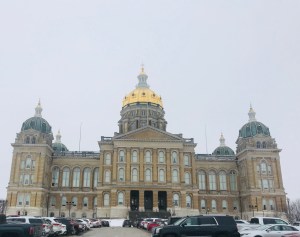
Iowa Capitol Building in Des Moines

Debate Done

By: Steph Attias

The days leading up to the debate there was a noticeable change in the hotel atmosphere. Suddenly, there was security near our usual class meeting spot and we had to change locations. People-watching in the lobby became more interesting as Wolf Blitzer, Amy Klobuchar, Anderson Cooper, Andrew Yang, Chris Cuomo & many more notable people wandered thought the hotel doors. I had the opportunity to meet Morgan Radford, an NBC correspondent who took an hour out of her busy day to speak with our class in an incredibly open and honest way. I was so excited to attend the debate!

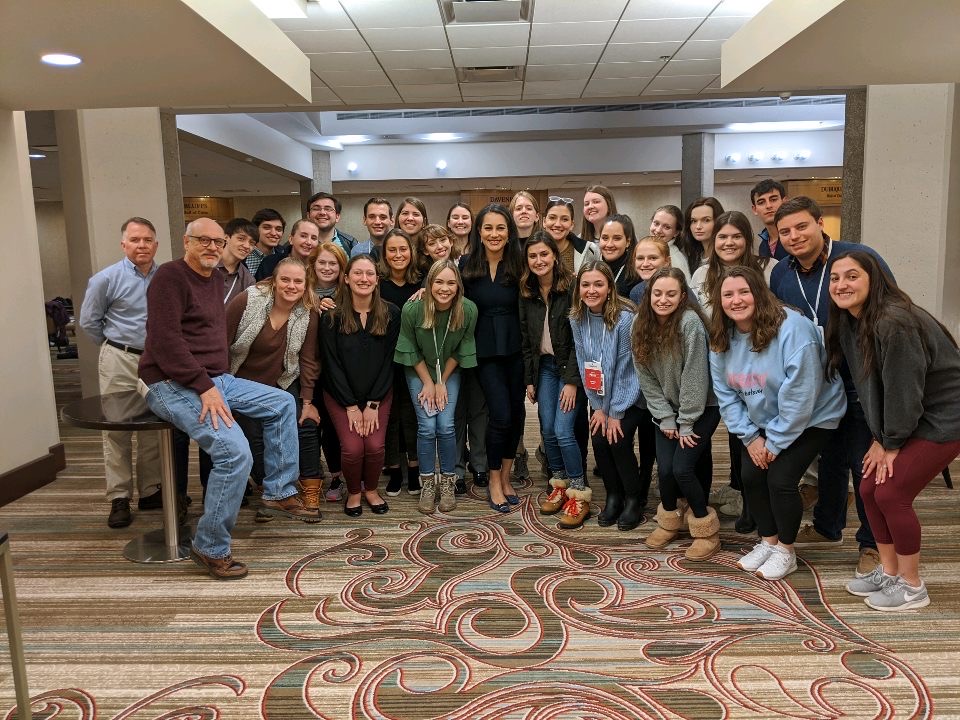
Class photo with Morgan Radford
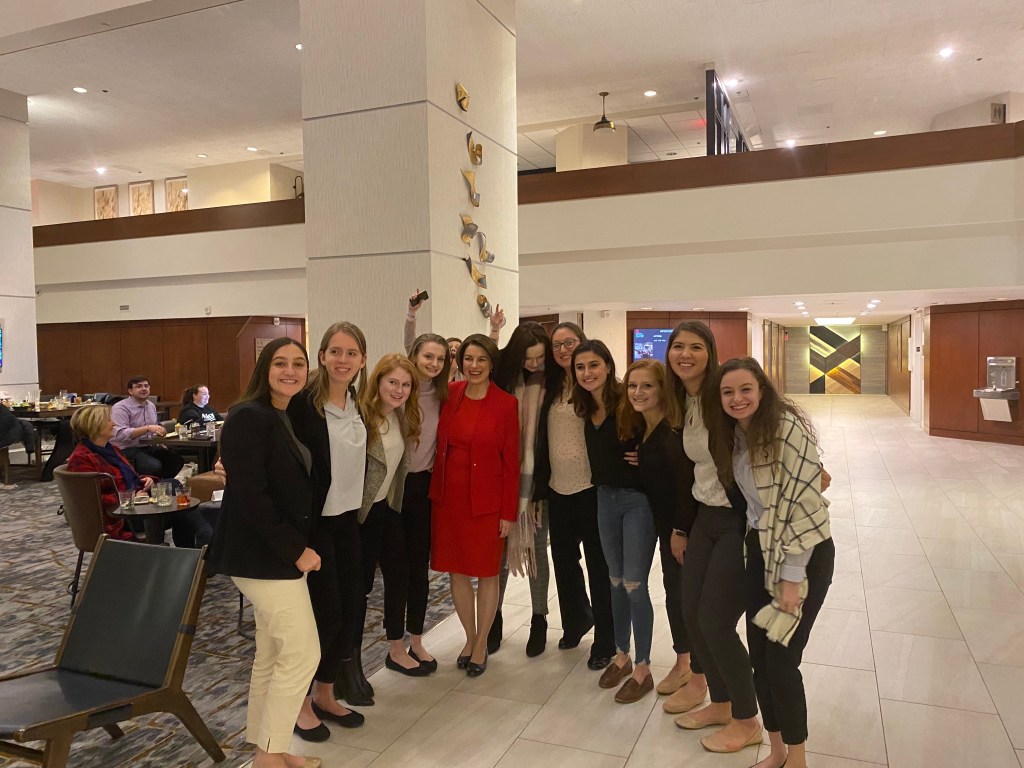
Amy Klobuchar in the hotel lobby
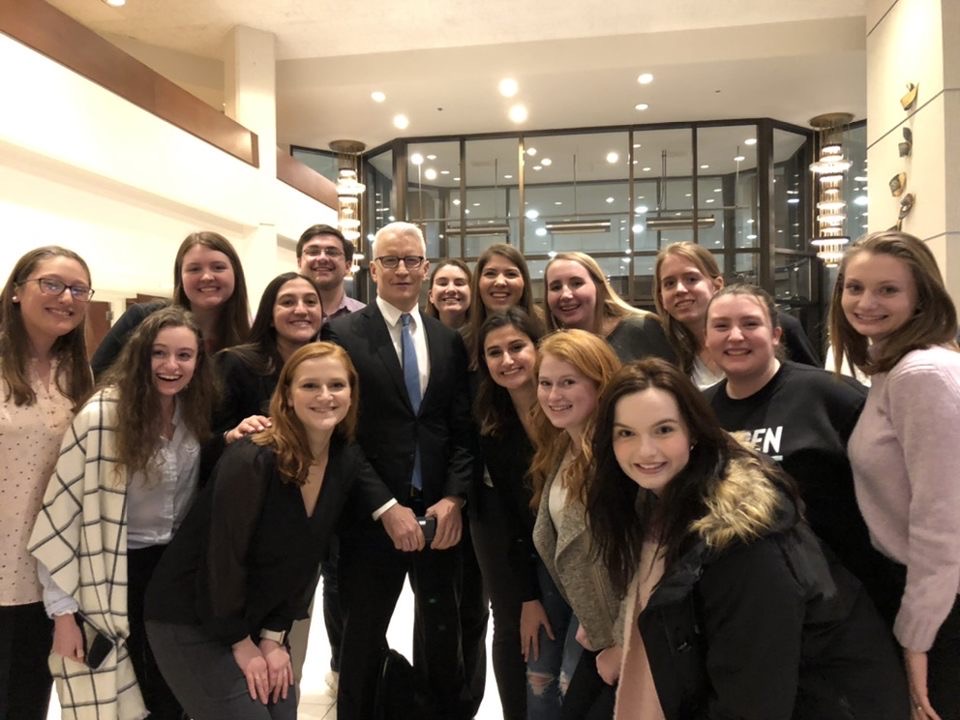
Anderson Cooper in the hotel lobby
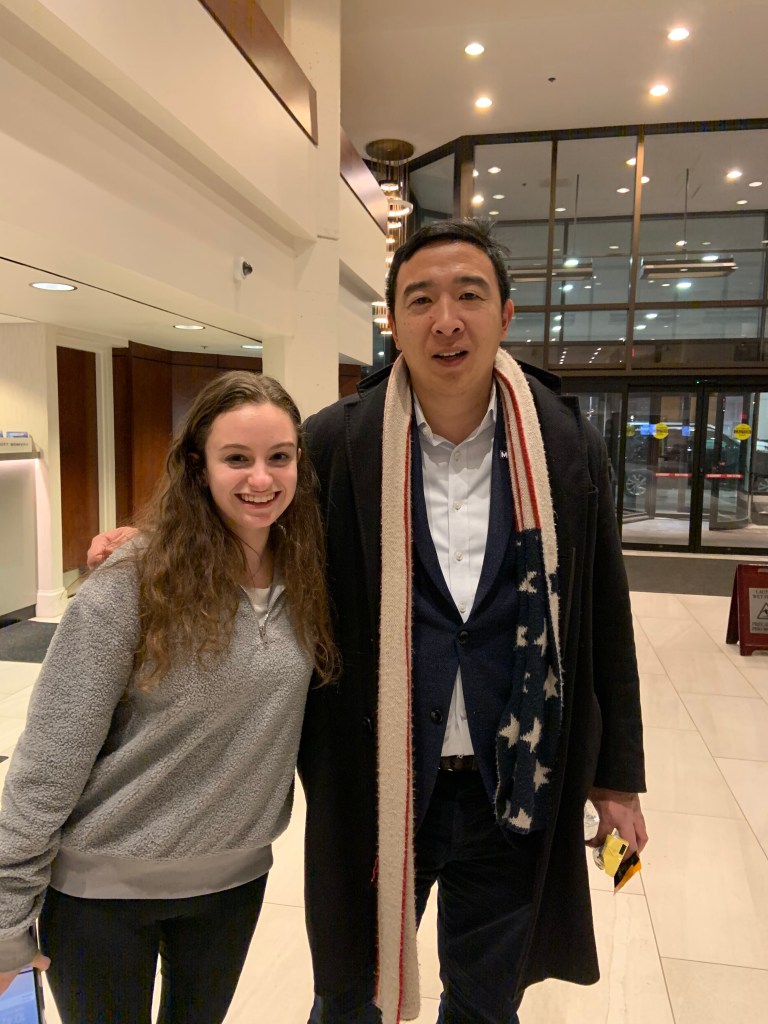
Andrew Yang in hotel lobby

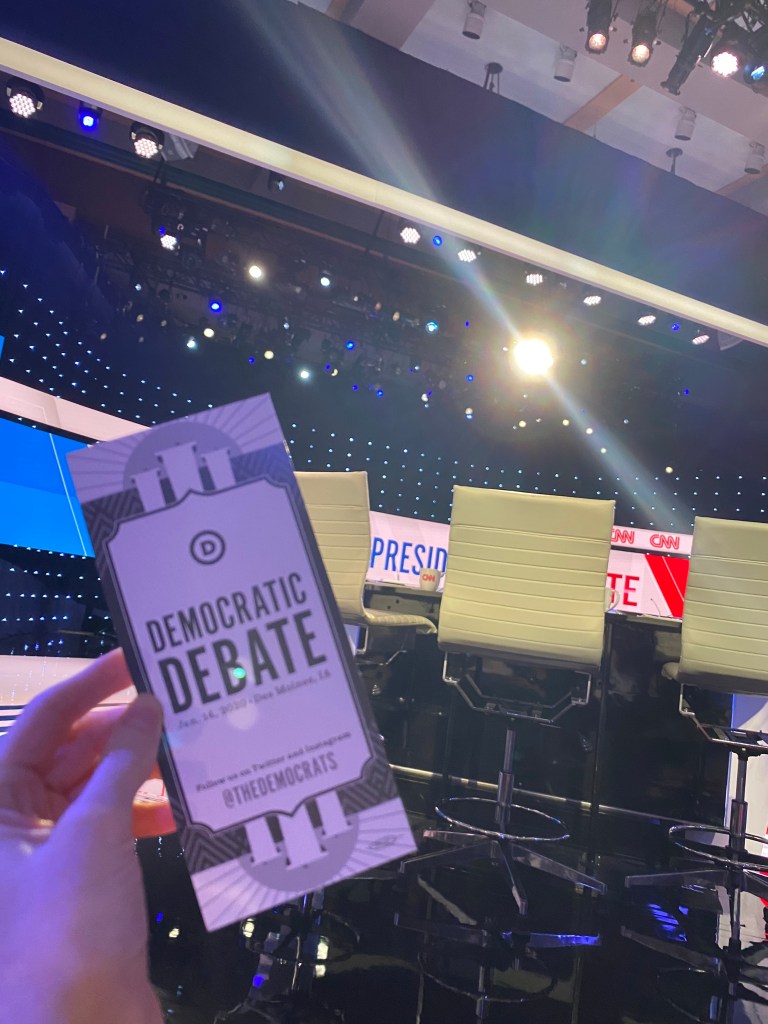
Being able to attend a democratic debate is something I never thought I’d be able to do. This trip has already been a whirlwind of unbelievable experiences, but this was something else entirely. The atmosphere in the room prior to the debate is infectious, bubbling over with excitement, energy and nerves. This is an experience I will never forget and will always be grateful for. Beyond being able to see presidential candidates debate live, a crazy part of the experience was the fact it was broadcasted on national television by CNN. I got text messages from friends and family letting me know they saw me on TV, which was so surreal. 

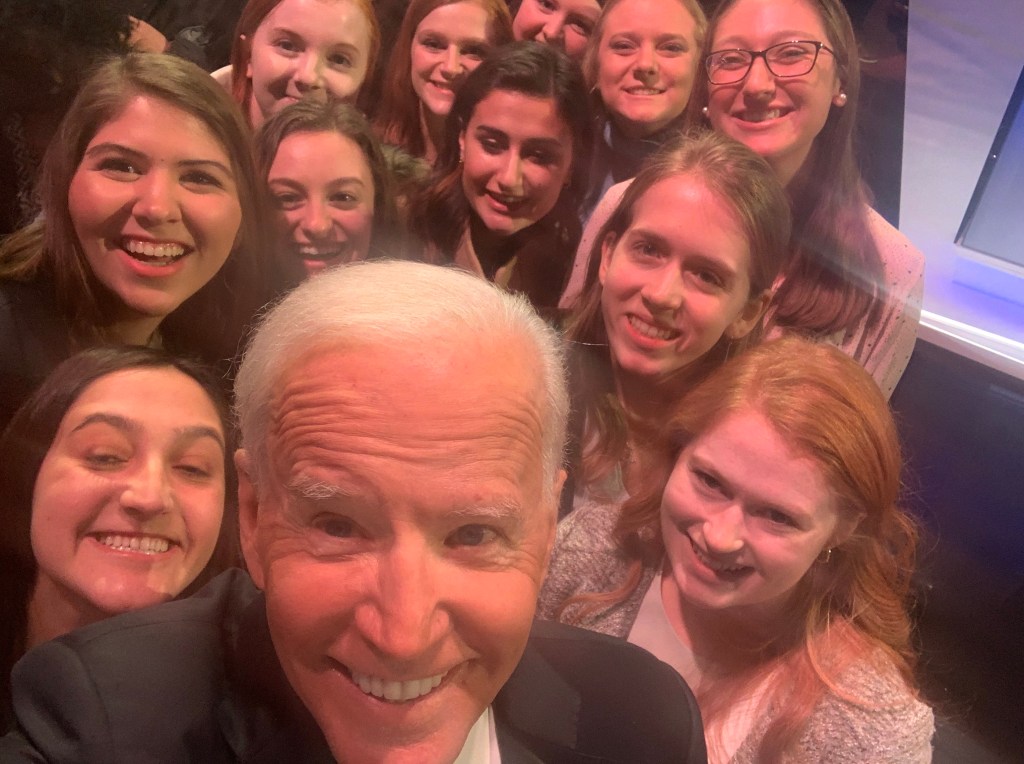
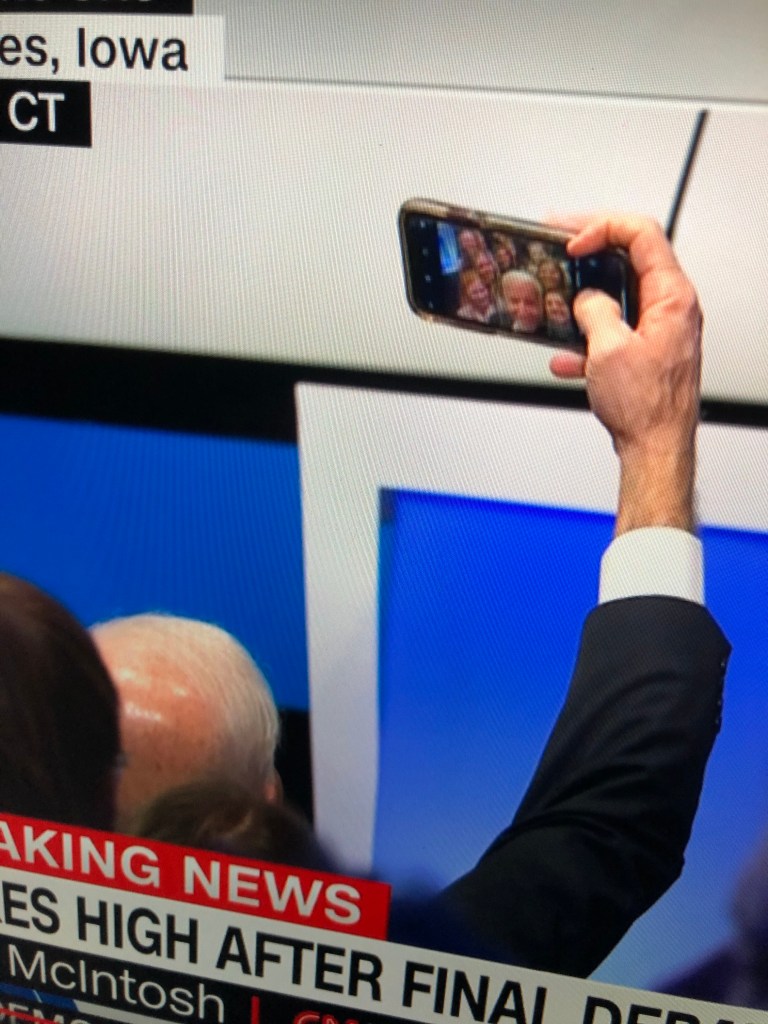
Selfie with Joe Biden
Selfie with Joe Biden caught on CNN
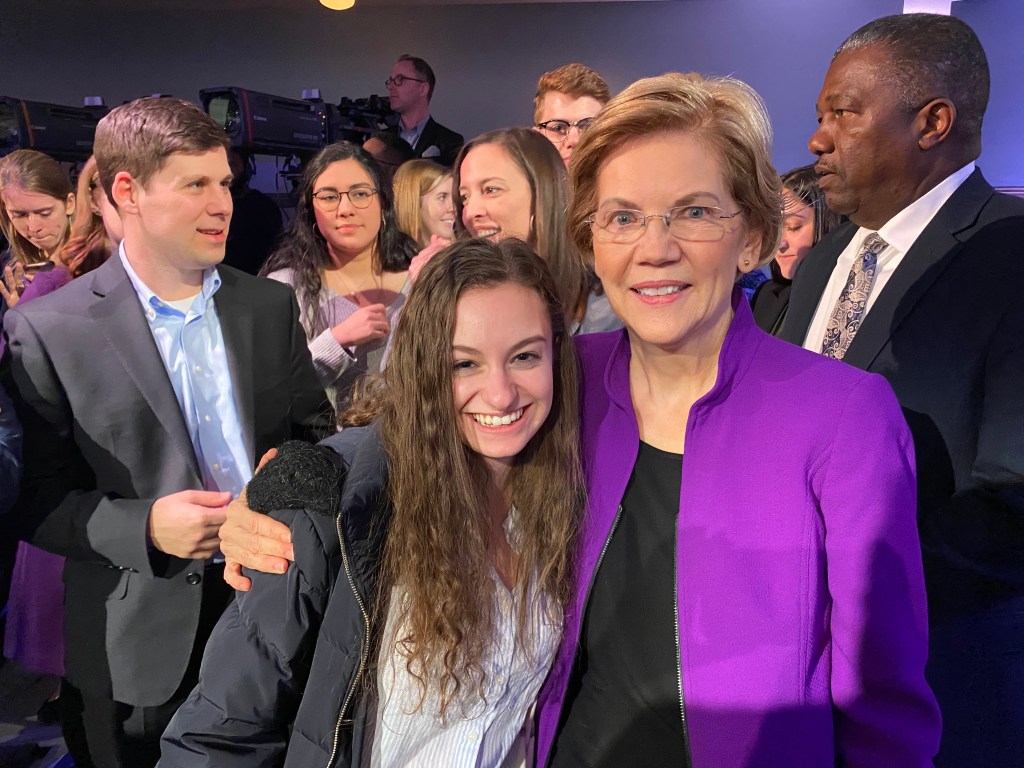
Photo with Elizabeth Warren post Democratic Debate

However, after the debate, the atmosphere changed once again. Iowa began to return every so slightly back to what it is when it is out of the national spotlight. While campaign events, candidates, and field offices full of staff are still in Iowa, much of the national attention has been turned away temporarily. This is due in part to the impeachment trial in Washington D.C, which forced many of the presidential candidates who are also senators to return to D.C.  The number of candidates near Des Moines has slowed down until the weekend and I’m feeling as though we are reaching the final stretch until the caucus day on February 3rd!

While I have not left the United States, I feel as thought my experience lines up with Elon’s global engagement goals. Prior the being in Iowa I barely knew anyone from the midwest. Know I having talked to countless Iowans, I feel as thought I have a much better understanding on what living in the midwest is like. Additionally, electing a presidential candidate is important to members of the United States, but in reality the whole world is watching. The results of this upcoming election will have an impact on the rest of the world.

Design a site like this with WordPress.com
Get started