We The People

            By: Andrea Sheetz

One of the things I was expecting in Iowa was the humanization of candidates. To see talking heads emerge from behind debate podiums and walk into elementary schools as regular people applying for a really big job was one of the reasons I signed up for this class. And I have not been disappointed. Marianne Williamson is smaller but just as passionate in person. Elizabeth Warren’s eyes light up when a question is asked about an area of policy she is particularly excited about. And the respect and admiration for his school-teaching husband is evident in his voice when Pete Buttigieg talks about education. The personalities of these candidates have radiated through their stump speeches and careful wording to remind us all about who they were before that FEC filing. 

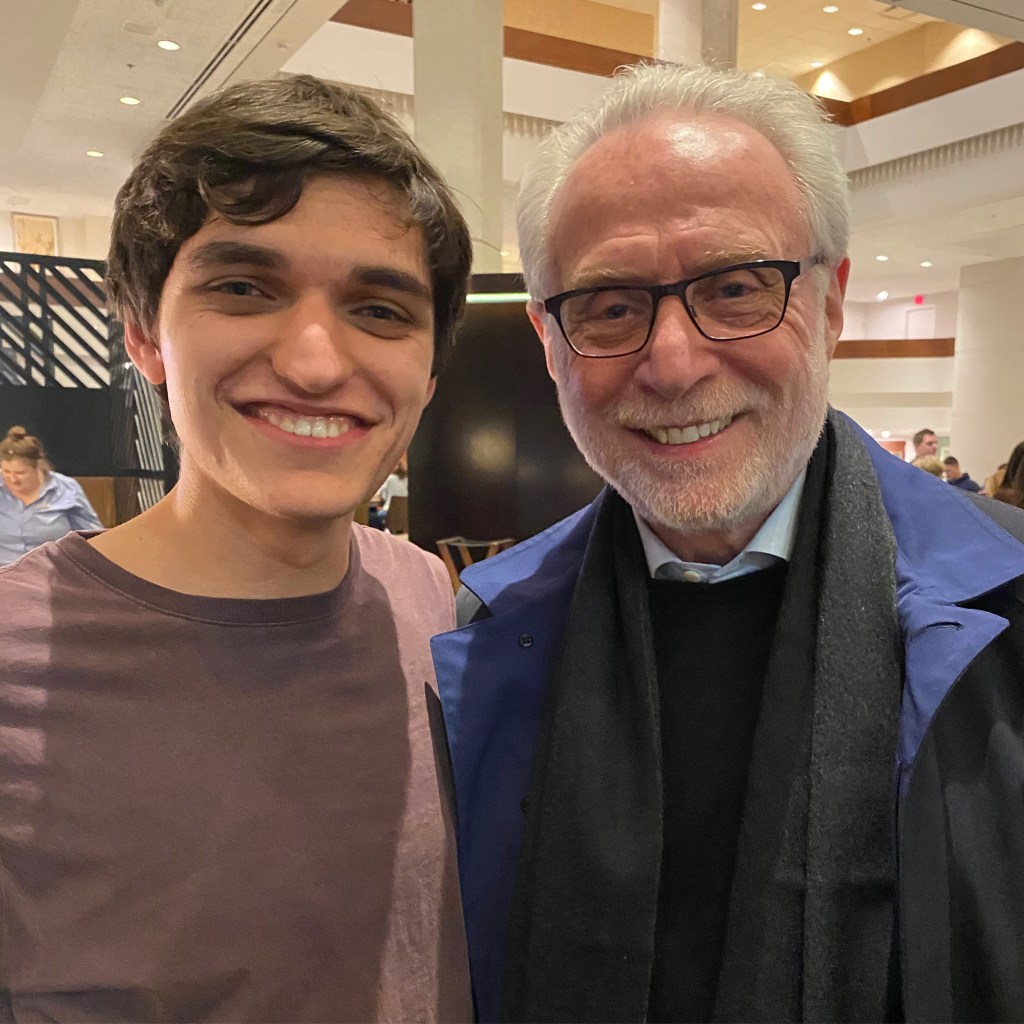
            I have also been impressed by the humanity of ‘political elites’ I have long admired. When a reporter asked a couple of my classmates if she could interview them and introduced herself, she was the author of one my favorite political newsletters, Lisa Lerer of the New York Times. When we talked, I brought up my favorite part and why I read her over the many others and was shocked to hear it was the same aspect of her writing she was most insecure about. When Wolf Blitzer walked into the hotel gym early in the morning, I was awed to say the least. It turns out he enjoys a nice walk on the treadmill, (unsurprisingly) watches CNN’s morning show, and wears the same sneakers as my dad. Although, his presence did push me to run a little faster. 

But what has impressed me the most are the people who make the caucus happen. Everyday Iowans are both the producers of the caucus and those who participate in it. On the first day at my internship here in Iowa, I was led into a storefront with over 1700 paper boxes that were partially stuffed with paperwork but needed to be finished and distributed to every single precinct. While we students did a lot of stuffing, so did staff members, who could make a lot more money working for campaigns or bigger organizations, but chose not to. Campaign staff and volunteers came to chip away at our droves of cardboard, with one U-Haul driver being the grandfather of a local caucus leader. I even witnessed one state representative come and fill his district’s boxes, literally bringing our national democracy back to his constituents. 

As I sit at all the various events we attend and get to know the people next to me, I never hear the same story twice. There was a registered Republican who does not want to support the President, but will only vote for certain Democrats and does not see the value in caucusing at the same event as someone my age who drove four hours to see his favorite candidate talk about her healthcare plan because he had to drop out of college to afford his HIV medication. And then I met two young men who grew up in Iowa, one never paid attention to politics until his friend became an event planner for a campaign. The other’s hometown was too small to warrant visits from candidates, but he found himself attending Drake University by way of a scholarship and now has political events steps from his dorm. 

This does not even begin to talk about the immigrant restaurant owner who introduced Julian Castro in the morning and served us some of the best Mexican food I’ve had later that afternoon. Or the countless waiters and waitresses, hotel staff members, uber drivers, and more who are open to our asking questions about them and the caucus. These active citizens are grateful for the access they have but remain critical of the celebrated candidates. There are plenty of politics in Iowa. But before, during, and after the caucus, it’s all about the people. 
What happens after a day of non-stop political coverage

By Maeve Ashbrook

Today is day five of our coverage of the Iowa caucuses. The day started with the news that Cory Booker suspended his presidential campaign after I covered him with our team on our first day here. Then, I ventured to Winterset, Iowa for a Pete Buttigieg rally and later back to Des Moines, Drake University specifically, for coverage of Andrew Yang. However, when our team arrived back to our hotel, we had the chance to talk with Morgan Radford, an NBC News correspondent. This was the highlight of my day.

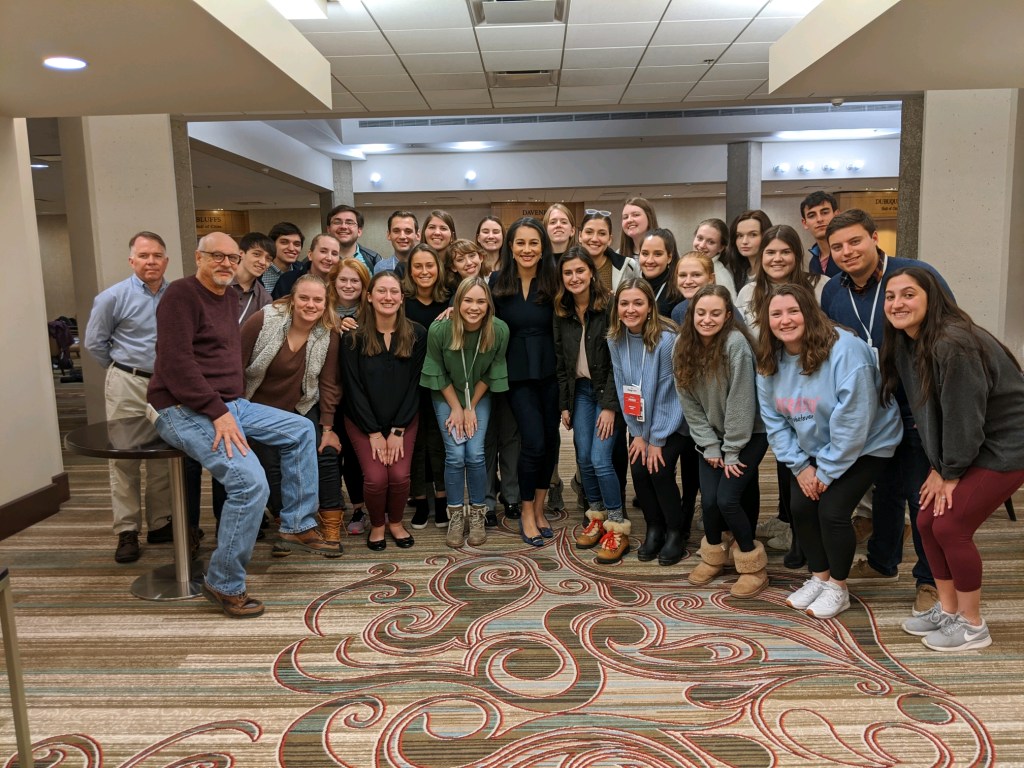
Morgan Radford takes a group picture with Elon University students.

Morgan talked to us about her path to journalism and why she has continued to work in the industry. Her path included getting knocked down numerous times and lots of no’s, and she said that when she finally got a yes, it was the most important. I asked her about her career path, and she said that it was a good question. That made my day.

Morgan also spoke on how a career that often times requires sleeping in a different city every night has affected her personal and social life. She is recently engaged, but she doesn’t live with her fiance. She also told us that she froze her eggs, because she wanted to focus on her career, one that she loves, but also wants to keep her options open. This was an inspiring story to hear. For years, I have told everyone I know about how I wanted to get married at 23 and have three kids by thirty. However, the journalism industry isn’t the most family friendly, especially for a 30-year-old with three children.

While I don’t want to shy away from having a family, women like Morgan make me believe that is possible to have a career and make decisions about your personal life that are best for you. I might not end up being a co-host of Sunday Today, but I have the power to have a successful career as a reporter that I love and am proud of and the power to have a successful career as a wife and mom that I love and am proud of.

So yes, interviewing presidential candidates and seeing my face on MSNBC are exciting moments that get my blood pumping. But, at the end of the day, it’s the moments that inspire you to become the best version of yourself that matter the most. And yes, I did write a blog post that included the phrase “three by thirty”. You’re welcome and most likely not surprised.

I’ve never been good at math

By Emma Greenberg

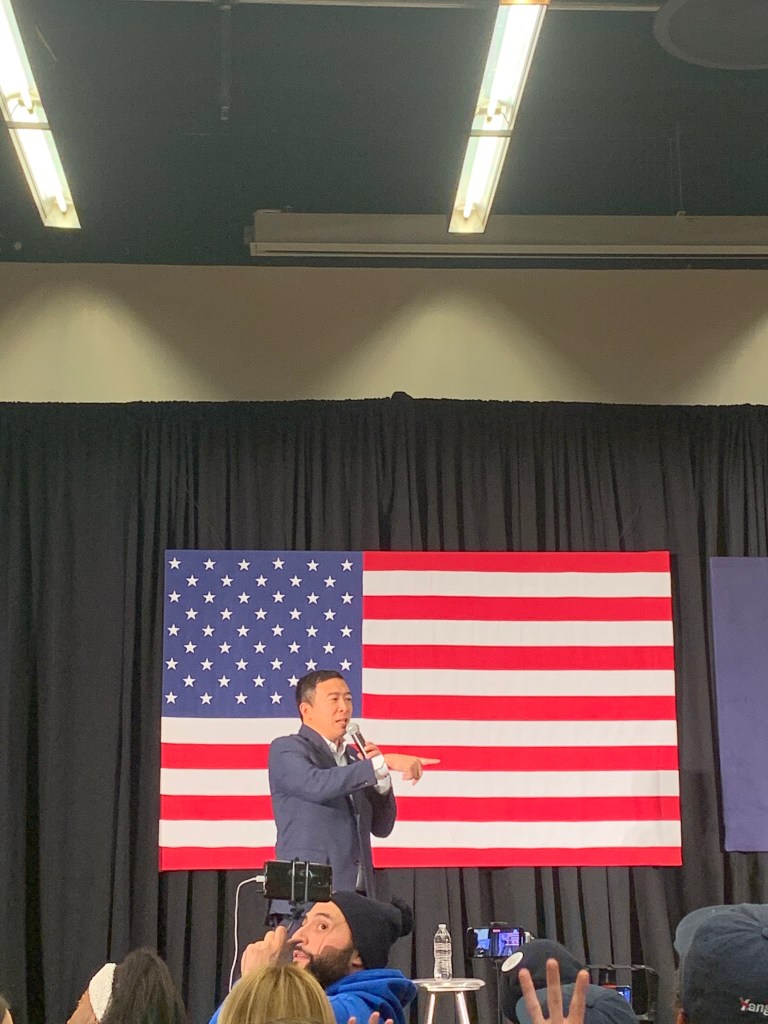
Today we got to see presidential nominee, Andrew Yang, at his Iowa town hall. I, like many in our class, had a lot of perceptions of Yang and his #YangGang. As a Political Science major, I have always held the strong belief that a politician, not a businessman, should be President of the United States. In fact, I think we have seen with our current administration how much can go wrong when we attempt to run our country like a business. Additionally, the only policy I really knew about Yang was his policy on giving out a “freedom dividend” of $1,000 a month, and that he claimed to be the opposite of Donald Trump, citing the biggest difference you can get from Trump is “an Asian who likes math.” 

With this in mind, when I walked into the room and saw people in “MATH” hats and sweatshirts with Yang’s face on it, I was immediately cautious. The #YangGang reminds me of the quote by Shakespear “though she be but little she is fierce.” The close knit following of the nominee is smaller than that of other candidates, however, they are all extremely excited and on board with getting the tech businessman nominated at the caucus only 21 short days away. His supporters cite that the only person the current President has not gone after is Yang. They take this as a good sign, believing that Trump is afraid of Yang, although I am not sure if I agree. To be honest, I believe that it is because the President does not see Yang as a threat.

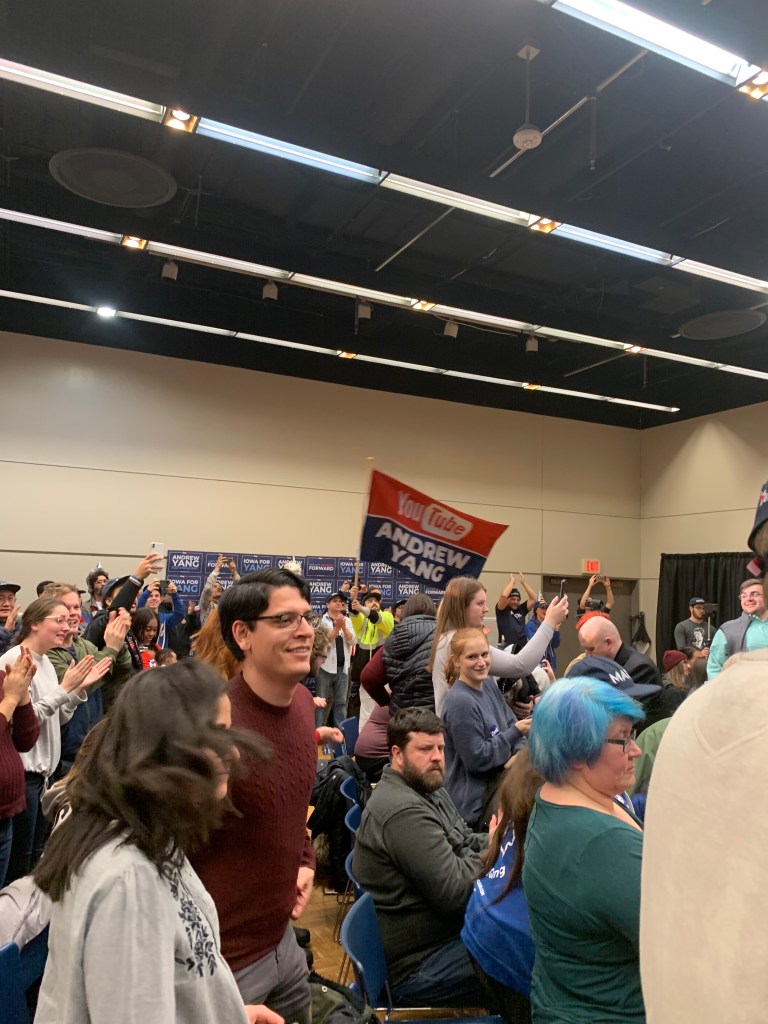
His supporters started singing “Happy Birthday” to welcome the candidate to the stage, and were all standing and cheering aggressively. In fact, there were many times Yang would pose a question and his supporters would instantly call out the correct response, without missing a beat. Yang discussed the theme that people are tired with the government, with being promised change that they never received. The son of immigrants, Yang embodies the idea of the American Dream and his supporters see that and they believe that he will help them achieve their American Dream too. Yang was able to explain the problems that plague America in a different way than I’ve heard other candidates. He uses humor and his business background, explaining what he learned while working with his non-profit. He described the 2016 election as Americans “taking a bet” on a huge change. Yang believes, after looking at the numbers, that Donald Trump won because of the manufacturing jobs that were lost in many swing states. 

Everyone cheering excited for Democratic candidate Andrew Yang.

Taking hits at organizations like the DNC and Amazon, he reminded people how he is “barely a politician,” and that he too can bring major change to the county. He repeated that “he’s a numbers guy” and how that will benefit his campaign. 

Andrew Yang brought up many interesting points during his speech. He promised change and he believes that the way to do this is doing the math, examining the numbers, and providing a better life. However, I still cannot tell you much about Yang’s policies and I still believe that we need a politician in the White House. Even if Yang’s policies are something I would support I believe that he would struggle in implementing the heavily promised change. I believe we need someone who knows how to work policy through Congress, someone who can work with their peers and get bills passed. By the end of his speech, however, I really understood how people who are tired of broken promises like Yang. The #YangGang might be all in for Andrew, but for me, something still doesn’t add up.

The man, the myth, the legend – Andrew Yang

A Whirlwind Affair

By Emery Eisner

What happened two days ago? Well, for one thing I was supposed to write this blog post. Unfortunately, my overflowing brain allowed this assignment to pour out. But I can tell you about my experience from Jan. 11 with greater clarity now, having that beautiful 48-hour hindsight. 

Two days ago I travelled to Newton, Iowa to cover a Bernie Sanders rally at a local middle school. Later, I wrote an article covering his talking points as well as the interest that college students have in Sen. Sanders. But what was most interesting to me was not included in any published piece. Together with my peers, I interviewed an Iowan who said he was still not fully committed to Sanders for the 2020 election, but that in 2016 the senator was his first choice. After former U.S. Secretary of State Hillary Clinton won the democratic nomination, my interviewee decided to vote for President Donald Trump. 

While he didn’t like Trump’s “erratic” behavior, he did say he agreed with many of Trump’s policies, including the recent killing of Iranian General Qasem Soleimani. 

The duality of Sanders and Trump is something that interests me as a journalist, and I have yet to fully understand what the implications of these voters’ attitudes could mean for the 2020 election, as well as what it means for the state of U.S. politics as a whole. What I can say, however, is that in my time in Iowa thus far I have observed a serious thirst for change, and that Iowans see the potential for that thirst to be quenched in several candidates. As was said during our class discussion last night, it’s anybody’s game at this point. 

Thank You

By Kenna Cramer

The Iowa Program consists of a seemingly similar group of students: highly ambitious, politically charged young-adults. This surface-level assessment is true in some regards; all of us would not be here without such a drive. However, this particular student body is innately diverse, which, I will not lie, initially gave me a reservation. 

My reservation does not stem from the concept of diversity itself (and in regards to diverse political affiliation) but, rather, the lack of interconnectedness amongst different groups within Elon itself. As a sophomore, I can confidently say that I greatly enjoy our university, however, it and, maybe the student body as a whole, perpetuates a segregated community. As stereotyped, those within Greek-Life Organizations (including myself) only fraternize with affiliated members, and other club-groups only socialize within their circle. I entered Iowa with such preconceived perceptions and, as a result, hesitations, which I have previously observed many others may hold as well. 

I recognize the wrongs within this view and am sad to admit I feel and view our university in this way. However, as this trip has progressed, I have felt these assumptions slowly dissolve, especially after last night’s meeting. 

After the Buttigieg town hall, as a class, we began our typical meeting. The meeting itself followed a town hall that, in of itself, was very emotionally charged for not only Pete supporters but outsiders as well. This resulted into a high-charged, high-tension discussion. In this discussion, I shared a difficult snippet of my life and mental illness. This was not only very emotional and difficult for me to express but I believe for others to hear; no singular student caused my emotional state, rather, my resonation with the presidential positions and exhaustion of the day (and lack of food) was the primary cause of this. 

Following the meeting, one of the other Pete volunteers and I were waiting for our dinner. In that time, a multitude of our fellow students came up to us and told us of their own battles with mental illness, thanked me for vocalizing my story, and/or apologized for “causing” my upset state. However, with this blog post, I want to take the time to thank all of my fellow students and our professors. Not only has everyone cultivated a comfortable sharing environment to allow for such difficult discussion to occur, but have enlightened me to how, despite our diverse Elon affiliations, are in fact all similar; we all care about one another. We, as an Elon community, care for one another despite our differences and, in turn, recognize the value in our differences. With such a chaotic, angry political climate, and the world in general, such simple kindness and empathy need to be cherished and spread; we, as Elon students, can help create a better, more accepting world.  

A Wolf walks into the lobby…

By Isabella Seman

This trip has been crazy to say the least, but a good crazy. As part of the journalist group we have been covering and working non-stop. We have covered Bernie Sanders, Elizabeth Warren, Bill Weld, Pete Buttigieg, Marianne Williamson, Cory Booker, and Amy Klobuchar. In fact, we were Marianne Williamson’s last interview before she discontinued her presidential campaign.

Yesterday was a long day, but the most rewarding day here. We covered Bernie Sanders and I ran the camera. Our press spot was between The Associated Press and The Washington Post which was a very humbling experience.

After covering Senator Sanders, we decided to produce a show for ENN. In the middle of producing it Professor Landesberg texted us to come meet some people from CNN. After sitting and talking for two hours we ended up meeting Wolf Blitzer, Sam Feist, and Ken Litwin. It was an amazing opportunity to talk with them and learn more about the media industry. Jack may have fan-girled a little, but Wolf is his biggest idol. Did you know that the major media networks rotate their camera alphabetically so only one camera is covering President Trump?

Jack and Wolf Blitzer

This day was long, but we covered Bernie Sanders, turned coverage of it, turned a show, and met some of the biggest names in our industry.

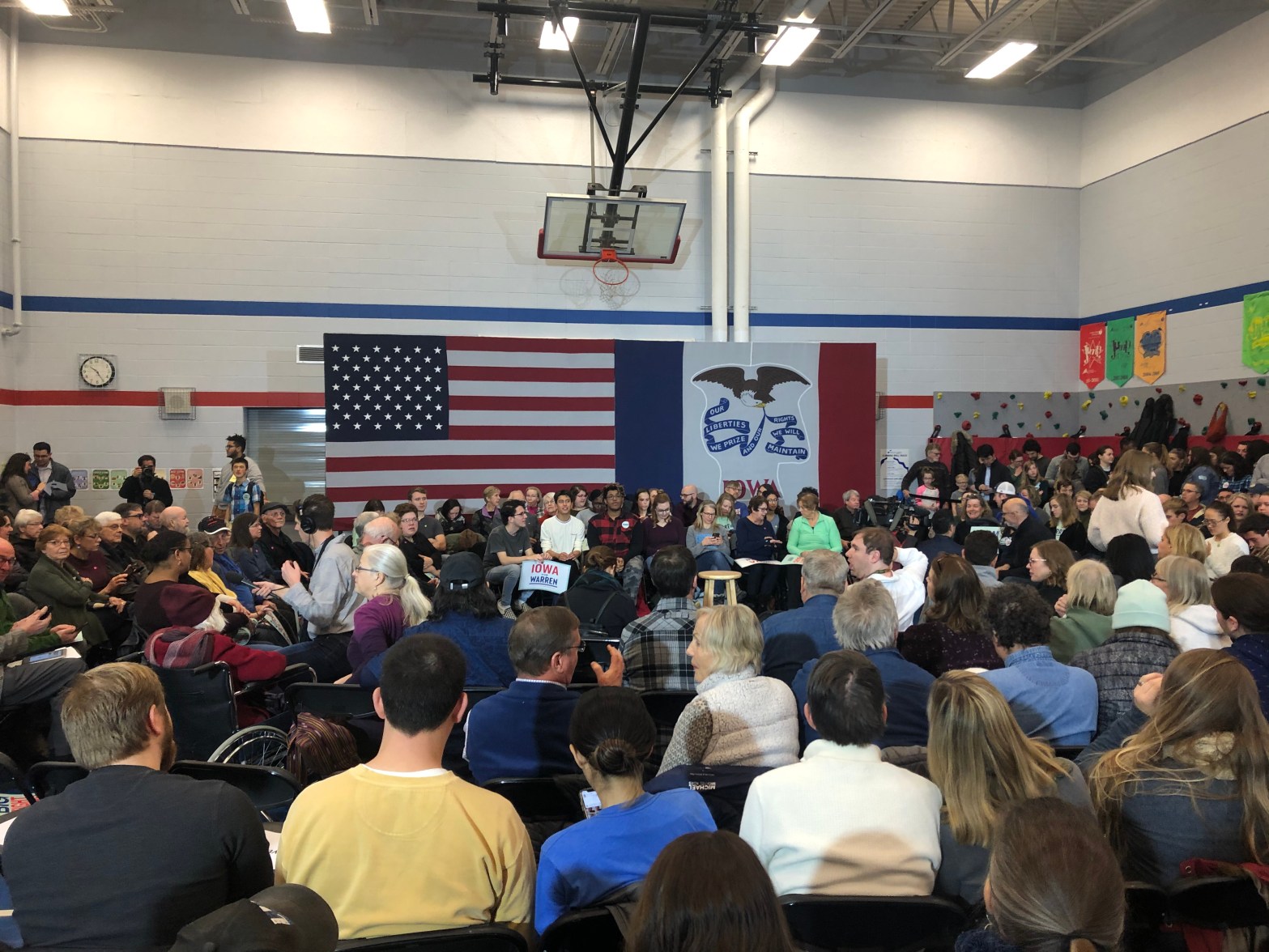
Today was just the same: busy, busy, busy. The work we are doing is very rewarding. This opportunity we are getting is unlike any other. I mean, getting to meet Wolf Blizter, come on! Today we covered Elizabeth Warren and Pete Buttigieg, two completely different rallies. Elizabeth Warren was in a small gymnasium with about 400 people. We interviewed Warren and her husband. Julian Castro was also speaking.

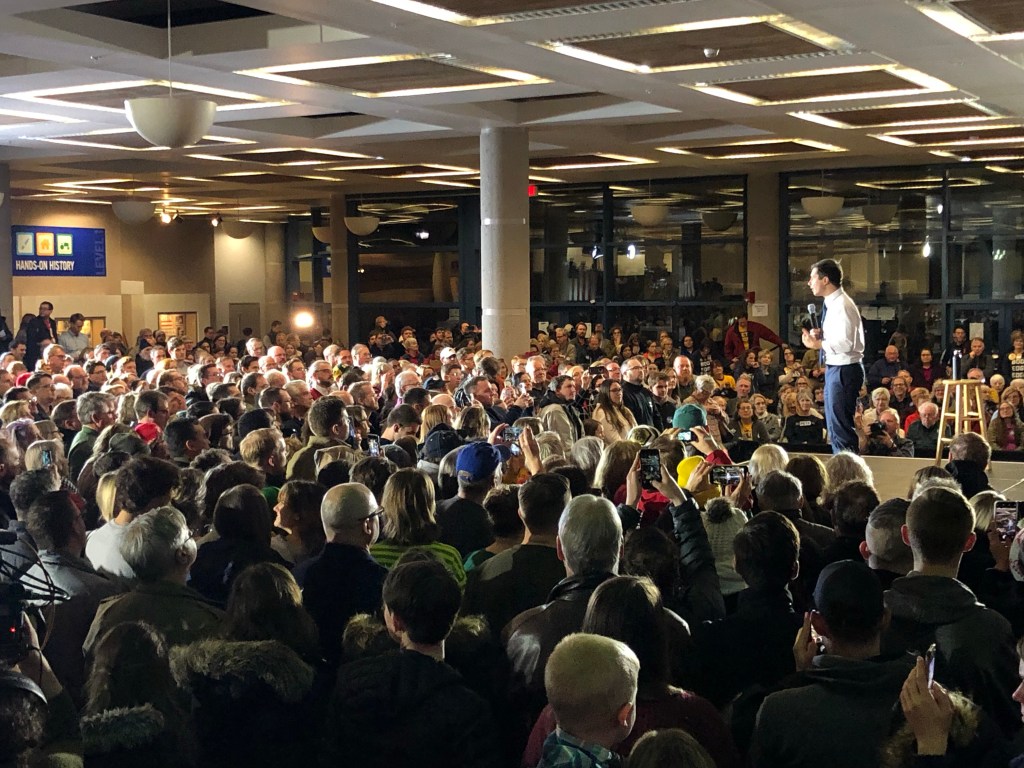
That night we covered Pete Buttigieg. This event was very different than the other events. Mayor Buttigieg was on a stage, while the other candidates were up, close, and personal to the voters. It felt more of a production than the other campaigns. While covering it there was a black lives matter protest mid-speech. It was interesting to see this because we interviewed the lady who protested before the event started. No other candidate that we have been to has had a protest like this one.

Overall, I am very thankful for the opportunities I am receiving. Getting to know the Iowans on a personal level is very heart warming. We have found that either Iowans are completely invested in the caucus, or they do not care at all. We continue to work sun up to sun down every day, but I wouldn’t change a thing.

Warren: the Modern Day Wonder Woman

By Jack Corby

Posted: January 13th, 2020. Updated: January 14th, 2020

In today’s political world, when you are at a rally and you see something orange walk onto the stage, you think a billionaire with fancy hair being trailed by men in black suits will follow. But, sitting inside Fisher Middle School’s gymnasium, the only thing that followed this orange blur was hope, prosperity, and black Nikes.

            I sit six rows deep, my back to the media team, cranking my neck to get a glimpse of Elizabeth Warren, the Senator from Massachusetts. My class and I had travelled a little over an hour to a small Iowa middle school to see the Senator, and her soon to be running mate Julian Castro, the former Housing and Urban Development Secretary under President Obama, speak. Castro is a former candidate and dropped out at the turn of the year, just to immediately back Warren and turn his efforts to supporting her, most likely in an effort to be sitting in the West Wing with her.

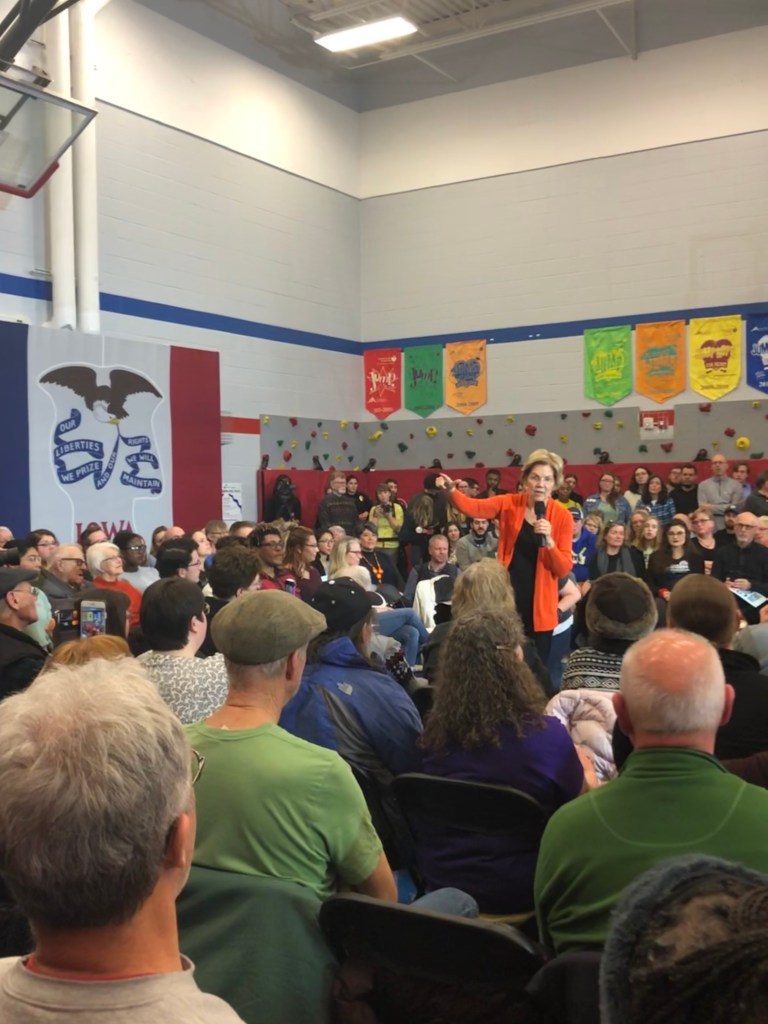
            As she entered the small pit that was created by the circling rows and rows of chairs, her smile brightened the room, bringing people to their feet and noises from their mouths and hands. She was dressed comfortably in black yoga pants, Nike shoes, and an orange sweater. But it was not the clothes that mattered, rather the person under them. Warren just simply captured the room and never let it go.

            She flowed from story to story of her childhood, weaving in her current policies and what needed to be changed in Washington, America, and the world. She used one-line humor to keep the audience engaged (“It is never good when you have to number your husbands”) and to keep the conversation moving. And when she made a strong point that gandered applause, she threw her right arm into the air and gave the room a big smile. While everything she said did not captivate me personally, she proved to me, a liberal moderate who loves Amy Klobuchar (going to plug her at least once a post) that Warren is no joke. And she is in it to win it.

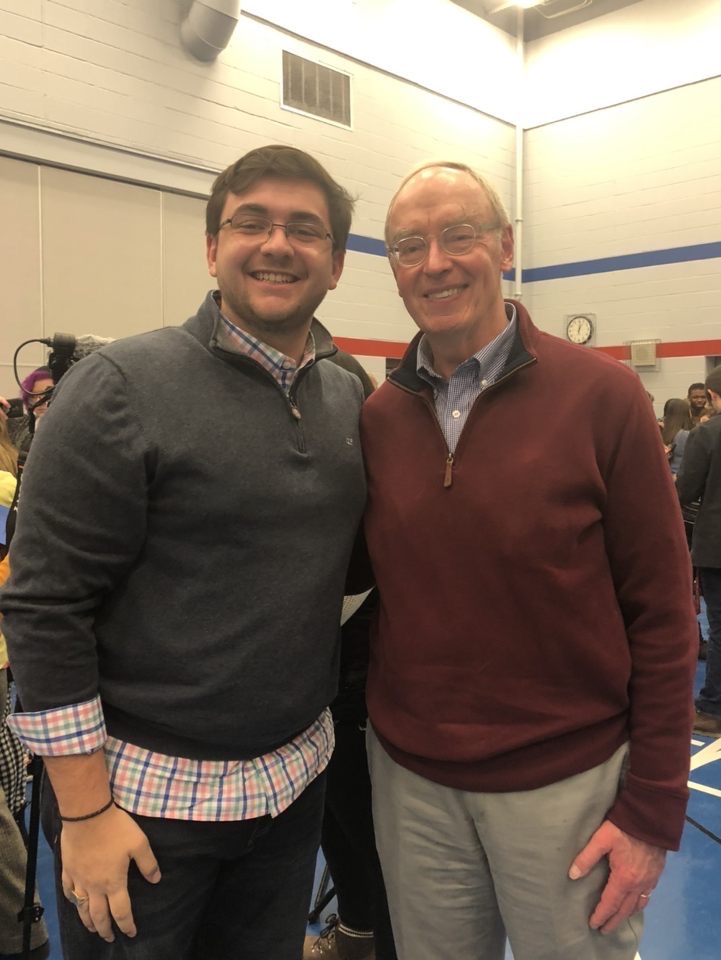
A lot of candidates run to get a name for themselves, make a little money, and fight for a cabinet position (see Castro). But Warren is not going down without a fight. The combination of her as President and Castro as VP is a deadly combo that will be very hard to beat as a pair, especially if Bernie Sanders cannot pull the African American vote from former VP Joe Biden. Add in her Harvard Law professor husband Bruce, pictured with me below, and Warren’s West Wing is shaping up to have a powerful, smart, and driven couple the world has not seen since the Clinton’s, maybe even the Kennedy’s.

Bruce and I after the rally. He gave me advice on law school, how to raise a dog, and shared a couple of jokes.

            After she was done talking about her polices, policies that include ripping away big corporations’ money from Congress and introducing a wealth tax on the top 1%, she took questions. Yes, I know that every candidate takes questions. But for Warren, these questions were unvetted, completely on the spot, and 100% honest. Other candidates will have people write questions on a piece of paper and put it in a bin, with aids sorting through the questions and only passing along the best, er, right ones (yes, even Amy does this. Sad).

            Elizabeth took each question honesty, again weaving in her past as a teacher and a law professor and a mother and a daughter and a friend. She related to many different types of people and understood them. She looked people in the eyes and smiled with joy or cried with sadness for them. She was amazing in the moment and very, very Presidential. She exhibited traits and qualities you cannot see on a debate stage, which will end up being a problem for her nationally for casual voters. And her polices were very left wing, a little too left for this moderate. But today, in a small middle school in Marshalltown, Iowa, she was invincible and poised to find herself working, and living, in a new place in DC come January 2021.

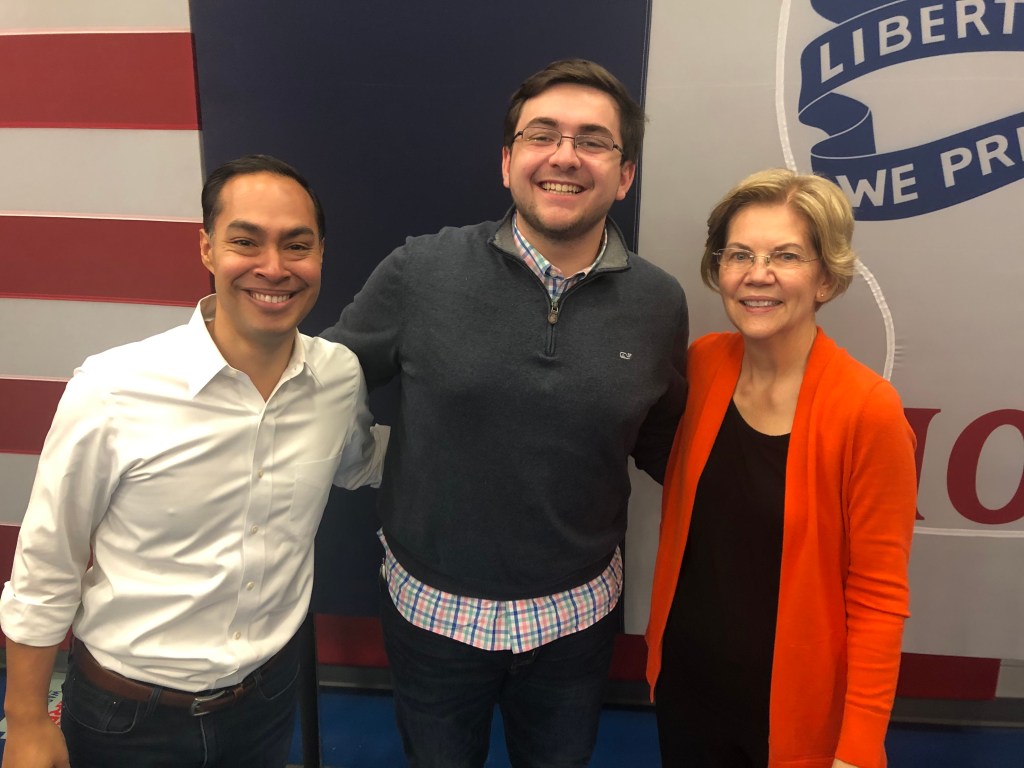
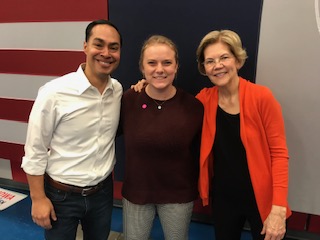
Former Secretary Castro (left), myself, and Senator Warren (right).

Candidates as individuals, not celebrities

By: Victoria Egan

The past two days have been a complete whirlwind, to say the least. Yesterday a group of us headed to Newton, Iowa to see Bernie Sanders speak at an elementary school. Going into this event I was excited to see the excitement of Bernie Sanders and the energy of a Bernie rally. When we got there, I was given the opportunity to sit in the seats behind the Senator. This was a unique experience because although I did not get to see Bernie’s face as he spoke, I was able to see the audience’s reactions. This morning we all headed out to Marshalltown, Iowa and packed in a very small elementary school gymnasium. The energy that I experienced in this room was incredible and Warren connected with her audience in a way that none of the other candidates I have heard speak have.

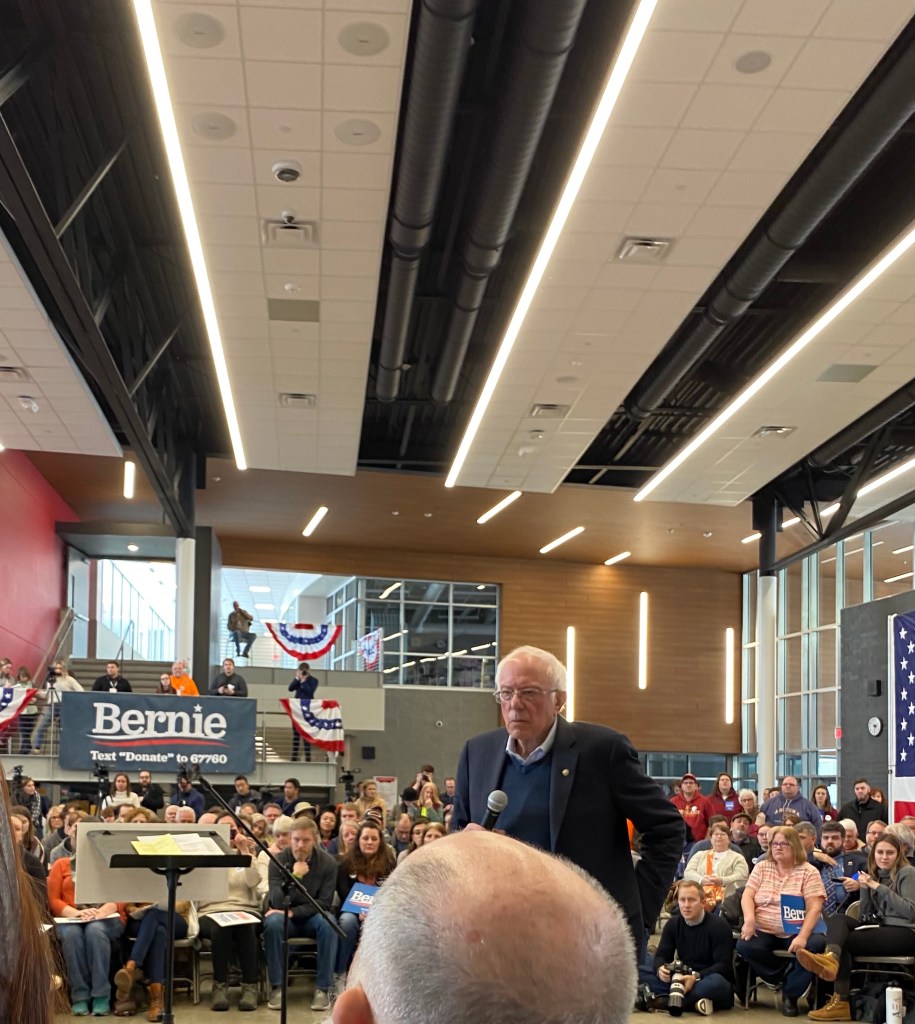
Bernie Sanders at his rally in Newton, Iowa on January 11
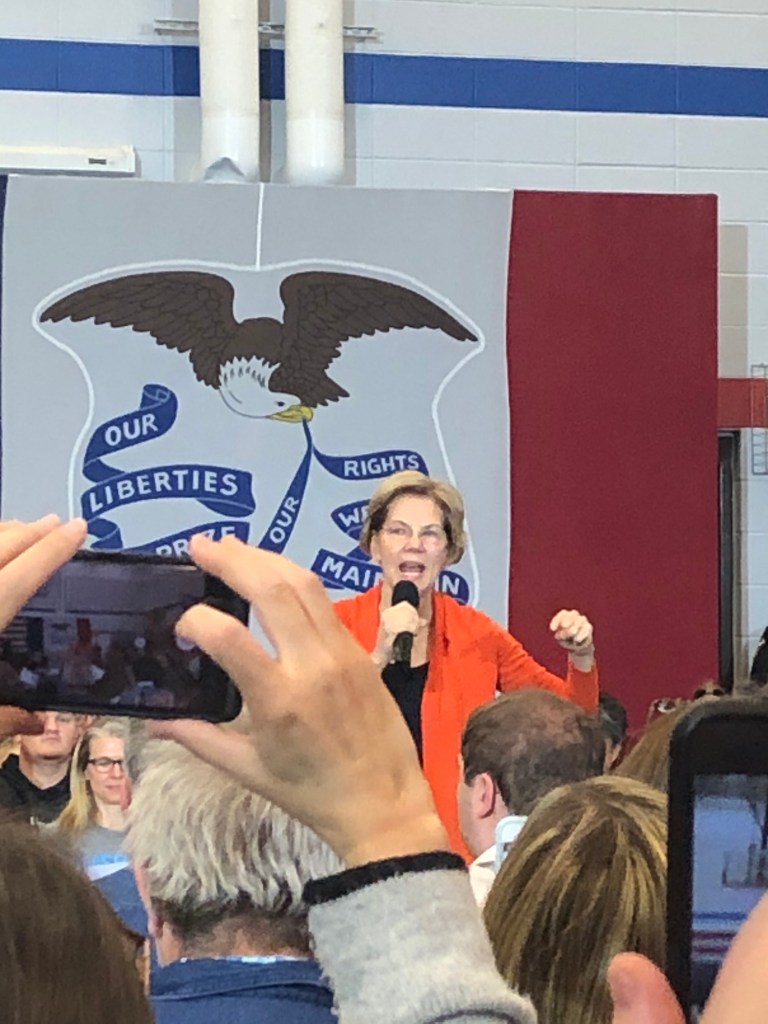
Elizabeth Warren speaking at her event in Marshalltown, Iowa on January 12
Pete Buttigieg speaking in Des Moines, Iowa on January 12

It is interesting to compare the different atmospheres of the three rallies. At Bernie, it did feel a lot like he was yelling at the audience about all of the wrongs that need to be fixed whereas Warren seemed to be rallying her audience more about what her administration’s plans were. Warren was addressing similar issues as Bernie but did so in a way that included the voters. She discussed her policy positions based on voter questions whereas Bernie just listed them off. Meanwhile, at Buttigieg, he focused on reuniting the nation in America after the current administration.

Aside from the differences in how the events were formatted, the biggest thing that I have taken out of the three rallies I have attended over the past two days is just how different the candidates are in person. We always see them on TV and they seem like such a foreign figure, an individual one can only dream of meeting or seeing in the flesh. However, in Iowa, they are simply just another human. Seeing these candidates is such a common occurrence for Iowans that when Castro walked into a Mexican restaurant we were in today, the locals didn’t flinch. A woman at the Elizabeth Warren campaign today that I spoke to said having the candidates ten feet away from them does not faze Iowans as much and the candidates are not as much of a celebrity to Iowans as they are to someone like me from the tiny state of Rhode Island. Although at the Pete Buttigieg town hall he was on a stage and the voters were standing, he was still connecting and engaging with the audience by directly addressing the individuals who’s questions were chosen. Additionally, there were several people who when waiting to take a picture with Pete after he spoke allowed others through as they had already met him. As someone from a state who never gets visits from presidential candidates, this was such a unique experience. These past two days I have seen political figures I only ever see on TV standing in the flesh ten feet away from me and they are experiences I will never forget and never take for granted.

2020 Visions

By Liz Crouse

In just one short weekend, candidates Bernie Sanders, Pete Buttigieg and Elizabeth Warren came to the Des Moines, Iowa area. As the race for Iowa and, on a larger scale, the White House heats up, the candidates are vying for support from any and all voters. As a student, I was fortunate enough to attend all three rallies. While each candidate had underlying, progressive messages, each of them displayed something unique to them: visions for the country in 2020 and beyond.

It’s easy to become beholden to the idea that each candidate is just a variation of another and of a “progressive prototype,” but after attending these three rallies, I have recognized this is far from true. The first rally I attended was for Vermont Senator Bernie Sanders. He’s known as a Democratic socialist, someone that people may refer to as “left of left.” His message was simple, but had complex underlying consequences. Revolution. Sanders wants to change everything starting with eliminating college debt and continuing to provide a government-based Medicare program for everyone. His tone ominous, Sanders reminded everyone about climate change and foreign policy crises. Overall, it seemed that Sanders wanted everyone to know that should he be elected, something big is coming.

VT Senator Bernie Sanders

Senator Elizabeth Warren, on the other hand, used the tagline big structural change. Using a softer and gentler phrase for revolution, Warren nevertheless insisted on changing policies for “an economy that works for everyone, and not just the top one percent.” Buttigieg, our final rally of the weekend, focused in on common values and a sense of belonging. He wanted listeners to know that everyone has a place in America, and “the only thing we don’t have room for… is hatred.”

Massachusetts Senator Elizabeth Warren and Former HUD Secretary Julian Castro
South Bend Mayor Pete Buttigieg

There’s lots of different visions floating around for 2020 and beyond, and it’s hard to make sense of them all. All three candidates we saw made compelling arguments for why they should be the next president. It seems to me that people gravitate to candidates for two reasons. The first is their personality. Who would you want to lead you? Who has the “it” factor that engages you, makes you want to vote, volunteer, and tell your friends? The second reason is their policies. Some people value women’s issues like abortion or issues like climate justice, while others value the authenticity or honesty of a candidate. 

When it came time for me to decide who I would work for while in Iowa, I took these two things into account. The answer was simple from there: Pete Buttigieg, the small town mayor whose ideals align with mine most closely and whose personality speaks to me. In a spirited discussion after his rally, I began to see what was true for me was not true for everyone. I was disheartened at first, but then I realized an important lesson. People need to engage with someone to make any change happen in this country. If more people engage with another candidate, they will win, and a change will be made. For me, I engage with Pete’s down-to-earth nature and his plans for physical and mental health care and his openness about religion. For others, these things do not resonate. And that’s good – it’s what leads to debate, discussion, and the formation of the best options for the future of our nation.

May the best candidate win.

To Vote or Not to Vote: There is No Try

By Jack Corby

Posted: January 13th, 2020. Edited: January 15th, 2020.

Ring. Ring. Ring goes my cell phone. I sit in an awkward, thrown together store front, fixed with folding chairs, makeshift desks, stacks and stacks of boxes, and loads of green ‘Iowa for Amy’ placards. The walls are hunter green and the store front sits next door to the VA of Des Moines. This is Amy Klobuchar’s Des Moines headquarters. It is 11am on a very cold, Iowa morning and I am working my way through a call sheet, trying to reach as many people as I can and hope I can persuade them to vote for Amy Klobuchar. Or, as I would soon understand, to just vote at all.  

Noah Stewart, the Des Moines Field Organizer, sits across from me, tapping away at his keys as he builds a ‘walkmap’, or basically a map of area that canvassers will canvass. The goal is to build a map of 47-53 doors into the same map, trying to group by like residences, like all single family homes, and keep distance walked as low as possible. It may sound easy, but once one map is built, the others become harder and harder to manufacture, making the task more and more daunting as you get into it.

As I start back on my call sheet with the Gs and Hs of Polk County, the county that houses Des Moines, I hit a voice that shocks me. On the other line, a woman tells me that she does not wish to talk to me, another “annoying caller” and that me calling will not change her mind on the caucus. She has lived in Iowa for 28 years, since finishing college, and has never once caucused. She even got mad at me that I would dare to suggest to her that she caucus, something she saw ‘no point’ in doing as “it does not really elect the new president”. I was baffled. How could someone ignore a call to duty like this? While she was correct, the caucus does not directly pick the next candidate or president, Iowa is a huge power shifter and can propelled candidates to do well down the road, just as Obama had done in 2008. And most Iowans I have met take great pride in the fact that Iowa is the first, and main, caucus.

As the conversation ended and I looked down at the call sheet, waiting for my hand to mark ‘refused’ on my sheet, I was just amazed. But, not just at the voice on the other line, rather that I played into stereotypes, something I was always taught not to do. I assumed because this person lived in Iowa and was older, as the sheet noted, that they would be gung-ho about voting and expressing their opinion and making a difference. It shocked me when that did not happen.

Looking back on the conversation, I realized it was much of my own bias, as outlined in one of the Global Learning Goals we looked at before we left Elon. I am very politically engaged. I love politics and love discussing it. I have grown up in a city that is fueled by the federal government and the ideologies that surround it. My high school was basically a funeral home on November 9th, 2016. Politics has shaped my world and my mindset, for better or for worse.

When evaluating myself after that situation, I realize now, more than ever, that not a lot of people have the political freedom I have. Not everyone has the privilege of being able to not only vote how they want, as I do, but that they can even get to the polls on election day, for a number of different reasons. Or even have the technology to request an absentee ballot, if they need one. Or even know that they need an absentee ballot. Or even have the education to make a sound, educated vote. Or what checking each different box means for not only them, but for their community.

This short, 28 second phone call really opened my eyes to things I knew existed but had never personally experienced in my hometown of Washington DC or my college town of Elon. Voting is a right that all Americans over the age of 18 have. But, they also have a right NOT to vote. People can choose just as well to stay home in November and let the world pass them by, if they choose. It is their right as Americans and one that must be respected. And I am glad for the person on the other line for making that choice, even if I disagree with it.

Design a site like this with WordPress.com
Get started